
STONE SOUP
Ontario is remaking its economy, and agri-food belongs at the centre. It’s time to transform the sector’s approach as a chain.
Generated using Meta AI
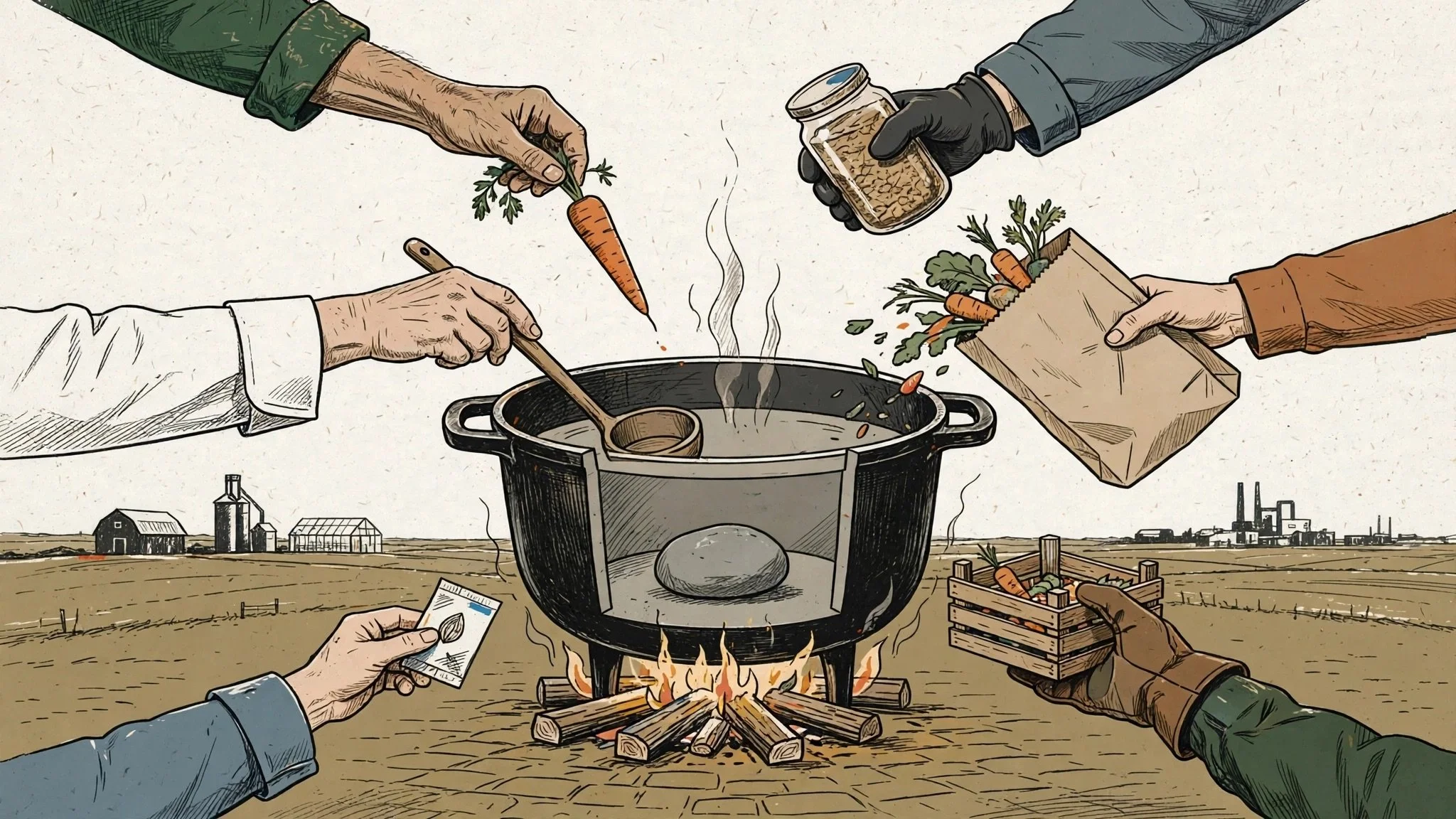
An old folk tale tells of hungry travellers who arrive at a village in hard times. The villagers, anxious about the winter, hide what little food they have. So, the travellers set a pot of water over a fire in the square, drop in a stone and announce that they are making stone soup: “delicious”, they say, “though better with a carrot”. One villager fetches a carrot, another an onion; then come barley, salt and a little beef. By evening the village enjoys a feast, one that could not have been made by one household alone.
Nobody in the story is foolish. In hard times, guarding what you have is prudent. The trouble is that prudence practised by everyone separately misses the opportunity for the bigger feast.
Canada is in hard times, and its governments have concluded that that a different approach is necessary. "Nostalgia is not a strategy," Mark Carney told Davos in January. More recently, in Strasbourg, the Prime Minister proposed an alliance with the European Union spanning critical minerals, defence, AI, energy and finance, and seamless trade in "non-agricultural goods".
Those words were not a slight, but they also reveal something important, in Ottawa and at Queen's Park alike. Agri-food policy has long been heavily weighted towards farm policy; it now needs to be industrial policy for the whole chain, from seed to shelf.
The public policy frame: an institutional predisposition
Ontario's agri-food sector generated $52 billion in GDP in 2024 and employs 1 in 9 Ontarians. Food and beverage processing alone is the province's second-largest manufacturing industry, worth about $14.8 billion a year. Farming is an important part of the whole, representing about a seventh of the system's output and a fifth of the broader sector jobs.

The Ontario government already knows this. When the agriculture ministry was reorganised in 2024, it was changed to include agri-business with the then new Minister, Rob Flack, describing a sector that runs "from farm gate to consumer plate". But the underlying machinery and new frame of thinking and acting has yet to catch up with the name. And it’s important that they do catch up if the ambition to meet the sector’s growth potential will ever become reality.
To start, the ministry's biggest levers still sit largely around the farm gate, among them a Risk Management Program heading to $250 million a year within a budget of about $1 billion. Its expansion was welcome, earned and exactly what farmers wanted. But stabilization stops things getting worse; it was never intended to make them better. Moreover, it does little to add value down the value chain. It is the foundation, not the building.
Other problems in the sector, more often than not, run through other ministries. Processors' expansion hinges on power and transport; farm labour on federal immigration rules; farmland protection on provincial planning; and margins depend on a value chain in which farmers face a concentration of large retail grocers. Most of these levers belong to energy, transportation, housing and economic development, not agriculture. So, when governments pull the lever marked "farm", and wonder why the needle barely moves on the real potential of the sector, it is because the tools are outside the institutional levers of the Ministry; the needle is not stuck, it’s that most of the dial is elsewhere.
Guarding the pantry: change is hard
Why has the frame not changed? Partly because change is hard. People weigh a loss roughly twice as heavily as an equivalent gain. In agri-food, as in the village, every household guards its own pantry: farmers their support programs, processors their plants, retailers their margins, ministries their mandates. Each is prudent alone but together they create the potential feast.
Governments, for their part, reach for the levers they know. But, Ronald Heifetz of Harvard warns against treating adaptive challenges (think Trump’s tariffs) as technical problems with known fixes; a program can be announced, but a change of mind cannot.
This is the heart of the matter. What agri-food lacks is not potential, effort, money or goodwill, but a different way of thinking about itself. One of the hardest parts of change is escaping old ideas, and agri-food's oldest is that it is a constituency to support rather than an industry to build. Thinking differently means asking what would grow the chain, not what would protect a link. Acting differently means funding transitions, building projects, and convening rather than just lobbying.
Done before.
The good news is that agri-food has thought and acted differently – as a system – before. A couple of examples:
The first is about convening. Faced with low, volatile prices and interprovincial trade spats in the 1960s, farmers, processors, provinces and Ottawa built supply management in little more than a decade. Whatever one thinks of the system today, a sector that built it knows how to convene a value chain and redesign it end-to-end. It has made stone soup before.
The second is about enabling transitions. When free trade arrived in 1989, Ontario's wine industry was expected to wither. Instead, governments paid growers to pull out more than 8,500 acres of labrusca vines, and growers replanted with European varieties under the newly developed VQA standard that established a new consumer relationship. The payoff came indirectly to the farm gate with the development of a more robust wine sector: from about ten Niagara wineries before 1989 to more than 190 VQA wineries today, millions of wine tourists, and on the farm a lot more grapes with better markets.
Ontario applied the same whole-system thinking to cars in 2021, treating electric vehicles as a chain from northern mines to southern assembly lines. The execution has been bumpy and costly, but agri-food deserves the same billing as autos and critical minerals, and should borrow the method, if not the price tag.
Embracing the challenges and opportunities of change.
The practice of change means three things.
First, think in systems: measure value added, processing capacity and export diversification, not just production. ‘Grow Ontario’ has made a start: agri-food exports rose 10% in 2023, to $26.2 billion, beating its goal of 8%.
Second, build projects, not just programs. The government wrote its Special Economic Zones Act with mines and energy in mind. A food-processing cluster or a greenhouse corridor is economic infrastructure too.
Third, convene. Bring the whole chain to one table, from farm groups and processors to retailers, transporters and lenders. To work, these tables need clarity of purpose and tangible projects with a real business case and demonstrable ROI. But a value chain that pairs requests with a credible proposal for growth (wherever that happens in the value chain) will find Queen's Park more ready to build, provided farmers are not left as the weakest party.
The window is open. A trade rupture and a European invitation have put economic strategy on every table, Queen's Park's included. But windows also close. There has never been a better time to take advantage of the potential of the sector and lean into the required change that will be required to make it happen.
The travellers' secret, of course, is that the soup never needed the stone. Every ingredient was already in the village. What was missing was a pot, a fire and someone willing to go first. Ontario agri-food has its ingredients: the people, farms, processors and kitchens, laboratories, ports and capital. Queen's Park can supply the pot. The sector, which has more sway over the agenda than it often uses, can bring the rest.