
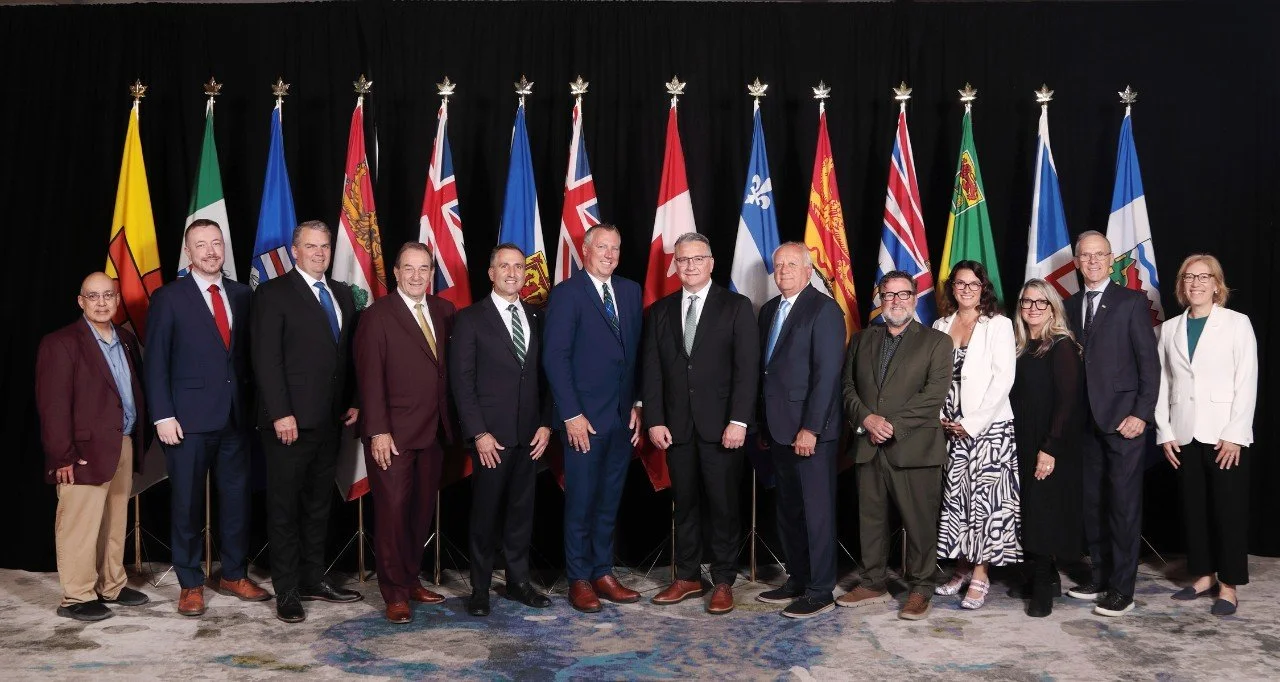
Halifax in July is beautiful. The waterfront is bustling with tourists and the food is divine. For those indulging in what the city offers there are few questions that can’t be easily answered: white or rosé; halibut or scallops? One of the big questions on the mind of Canada’s agri-food sector enjoys no such easy answer.
On July 17th, federal, provincial and territorial (FPT) agriculture ministers concluded three days of meetings in Halifax and issued the Halifax Statement. The document will guide billions in spending (budgets still to be determined) on federal-provincial agri-food programming for the five years following the expiry of the existing national agreement. It runs to several pages of vision, principles and priorities.
Notably, it does not mention the National Food Security Strategy (NFSS), the $3.2-billion federal program that Prime Minister Carney had personally launched five weeks earlier. The Statement’s four pillars (economic growth, market diversification, science and innovation, sector resilience) track closely with the language the NFSS uses to describe its own ambitions. The overlap in substance makes the absence of a reference more conspicuous, not less. We flagged this risk last month. Writing about the NFSS at launch, we asked whether it was the federal statement of intent that the Next Policy Framework (NPF) would be built to implement, or a parallel initiative running beside it. Halifax has now answered that question by declining to ask it.
WHY THE SILENCE?
Two explanations suggest themselves. First, and the less interesting, is sequencing. Phase 1 of the federal NPF consultation, the process that produced the Halifax Statement, closed in June, drawing on input that provinces and territories had been submitting for months. On this reading, nobody excluded the NFSS from Halifax so much as the machinery that produces an FPT statement was simply running on a track laid down before the NFSS existed. Ministers also had plenty else to occupy the agenda without reaching for a five-week-old federal program. They reviewed Business Risk Management (BRM) programming, agreed in principle to AgriStability changes, and deferred a decision on the AgriStability payment cap. A table already negotiating its own long-standing files has limited appetite to absorb a new federal initiative it did not design and was not consulted on.
There is also a cultural dimension at play. FPT agriculture is among the most consultation-saturated venues in Canadian federalism. Its institutional rhythm is built around stakeholder management: permanent working groups, two-phase engagement processes, industry advisory tables. The Halifax conference itself was structured accordingly, with a Canadian Federation of Agriculture policy conference preceding the ministerial agenda. The natural output of that culture is process legitimacy. What it is structurally incapable of producing is a fast, singular, politically ownable deliverable. Consensus among thirteen governments and their stakeholder ecosystems is the product; policy outcomes arrive later, if at all, wearing the process’s fingerprints rather than any one government’s. Indeed, we recall one stakeholder imploring the FPT ministers to break out of this historic mode and simply “try something different, with a real push for action in the near-term”.
The second more interesting explanation is that the NFSS was built deliberately to not need the FPT table; that the silence in Halifax reflects the federal intention to move unilaterally if necessary and the provinces declining to lend it their signature. Look at how the NFSS actually moves money. The Strategic Response Fund and the Food-Link Fund flow through Innovation, Science and Economic Development Canada (ISED) and the Regional Development Agencies, not through Agriculture and Agri-Food Canada’s bilateral agreements. The Canada Groceries and Essentials Benefit pays households directly. Tax measures are federal by definition. None of this requires a provincial cost-sharing signature the way NPF programming does. If the NFSS was engineered to route around the FPT process, provincial agriculture ministers have little reason to write it into a statement they own; doing so would concede a degree of federal primacy over the file or imply cost-sharing obligations that were never negotiated. Seen through that lens, the NFSS did not merely happen to bypass the FPT table; it could not have been built there. A government confronting grocery-price politics in its first full year needed a strategy it could announce and defend on its own timeline.
SO WHAT?
Whether this separation should trouble anyone, depends. There is a respectable case this is federalism working roughly as designed. The FPT track protects what genuinely requires consensus and durability (risk management programs, cost-shared frameworks and regulatory alignment across thirteen jurisdictions) and none of that should move at the speed of a prime ministerial grocery-store visit. The federal government, meanwhile, retains the capacity to act where urgency demands. Two tracks moving at two speeds is arguably more resilient than a single track that must either paralyze the fast agenda or steamroll the slow one. Separation, on this view, is discipline.
The case for concern is that the separation is unmanaged; confusing at best, chaotic at worst, and a risk to the policy and political success of both. A deliberate two-track architecture comes with coordination mechanisms: a crosswalk between NFSS investments and NPF priorities, aligned programming and shared metrics. None of that (currently) exists. The risks that follow are practical: contradictory program signals, stakeholders arbitraging two tables against each other, and muddled accountability when the tracks collide or fail to deliver.
Both explanations are probably true in part. But they point toward different futures, which is why the distinction matters. If Halifax’s silence is institutional lag, the NFSS should surface once Phase 2 stakeholder consultations begin this fall, with pieces of it appearing in the closed-door NPF negotiating text as the machinery catches up to the politics. If it is boundary-drawing, the two tracks stay formally separate with different lead departments, different ministers accountable, different metrics of success and the next mention, or non-mention, of the NFSS in an FPT document becomes a genuine signal, not an oversight to be corrected.
We would offer that the two-speed structure is a strength, and the absence of any articulated relationship between them is a problem. The remedy is to decide, deliberately, how the tracks reinforce each other, and, who owns what.
A MATTER OF PROOF
A final consideration confronts both tracks and should equally discipline both. The sector (FPT governments and stakeholders alike) has spent the past two years winning the argument that agri-food belongs alongside energy, critical minerals and defence as a strategic economic priority. The NFSS made the case rhetorically at the highest level and the Halifax Statement’s economic-growth framing echoes it. But the claim remains asserted rather than demonstrated. Canada now has an abundance of statements, strategies, frameworks, consultation phases and negotiating mandates and a conspicuous shortage of projects proving the sector can actually deliver against the national economic imperative it invokes.
Consider the canola example already in front of the country. When China imposed duties of up to 100 per cent on Canadian canola, disrupting roughly $4 billion in annual exports, one of the more credible longer-term responses was to crush and process more of the crop at home and convert it into renewable diesel. This turned a trade shock into domestic value-added processing, energy security and clean-fuel supply at once: the kind of dual-use project that demonstrates agri-food’s centrality to Canada’s economic success. New prairie crush plants give Canada the capacity to process three-quarters of its own crop; a $720-million renewable diesel facility in Alberta came online capable of absorbing 2.5 million tonnes of seed annually. But similar initiatives have stalled. It is the most visible economic proposition in Canadian agri-food, and the most instructive, given how government responded.
The lack of progress on scaling crush capacity demonstrates exactly what this brief has been describing: the existing structures and relationships could not own it, at least, at the speed of business. Farm-income consequences belonged to agriculture ministers; clean-fuel demand levers to environment and energy; the trade file to Global Affairs; processing investment to ISED. Relief arrived through none of them: a one-off Prime Ministerial announcement in September 2025 (a biofuel incentive and regulatory amendments assembled outside both framework tracks) which the sector promptly judged insufficient. That the pressure has since eased sharpens the point rather than diminish it: the tariffs came down through diplomacy, not because Canada built the domestic demand structure that would make the next shock survivable. A genuine dual-use project fell into structural purgatory; ad hoc politics, not deliberate policy architecture, was what reached in after it.
The opportunity and imperative of the next twelve months is not whether the NPF produces an elegant framework or the NFSS hits its launch milestones, but whether either track, or better, both in concert, can carry a project of this scale from crisis response to durable strategy. Sectors earn strategic status through evidence. The statements are written. The proof is overdue.
Ottawa has two flagship food strategies in motion, run by different ministers, funded through different mechanisms and, on paper at least, apparently unaware of each other. Both describe the same sector potential and the importance of its success to the national interest. How to move this forward is a question the Halifax Statement was entirely capable of answering. For now, it has chosen not to.